Lime training days on site for the Canal and River Trust and their volunteer groups

Lime training days on site for the Canal and River Trust and their volunteer groups
Canal-side volunteer groups and maintenance teams occupy a distinctive position in heritage conservation. They work on structures that are both historic infrastructure and living waterways, where masonry faces constant dampness, cyclical loading from lock operations, and the peculiar demands of an environment that never fully dries out. For these groups, lime mortar training cannot simply replicate the curriculum offered to general building conservation students. Our on-site training days are calibrated to the specific material realities of locks, bridges, culverts, and retaining walls.
Subject Knowledge: Understanding Why Lime Matters in a Waterway Context
Before any practical work begins, we give groups a solid grounding in the material science and conservation philosophy that underpins lime use. We evaluate the lime cycle and the spectrum of lime binders and the role they play for work on canalside structures. Participants will learn the difference between non-hydraulic lime putty, hydraulic limes (both natural and formulated), and hot lime mixes, and—critically—when each is appropriate. This is not academic pedantry. A canal lock chamber wall that is permanently damp on one face and exposed to air on the other presents a different moisture profile from a dry inland cottage, and the choice between a putty-based mortar and a hydraulic one has real consequences for breathability, set time, and durability.
Closely related is the subject of **sacrificial mortars and salt management**. Canal masonry is routinely exposed to groundwater and runoff carrying dissolved salts. The principle that lime mortar should be more permeable and less durable than the stone or brick it binds—so that it decays preferentially and protects the masonry—is fundamental. Groups should learn to recognise salt crystallisation patterns on canal structures and understand why repointing with cement-rich mortars, however tempting for its rapid set and apparent strength, traps moisture and accelerates decay of the historic fabric.
A third essential subject is aggregate selection. Canal-side work frequently involves pointing around setts, coping stones, and brickwork where the joint profile and finish matter as much as the binder. Understanding how sand grading, clay content, and aggregate colour affect workability, permeability, and visual match separates competent repointing from invisible repair. Groups should be able to look at an existing joint and deduce what sort of sand was likely used, then select or blend a replacement that will weather sympathetically.
Practical Training: From Mixing to Tending
The practical component is organised around the actual tasks canal groups perform, progressing from controlled bench work to live-site application.
Practical Module One: Mortar Mixing and Consistency. Participants will learn to mix mortars by hand and with a forced-action mixer, using both putty and hydraulic binders, and to judge consistency by feel rather than by strict ratios alone. The goal is a mortar that is workable on a trowel, adheres to damp masonry, and will compact into a joint without shrinking excessively.
Practical Module Two: Joint Preparation and Raking Out. Canal masonry often presents joints that are eroded, contaminated with vegetation, or previously pointed with cement. Participants will learn to rake out to an adequate depth without damaging arrises, to remove failed cement pointing without gouging the masonry, and to clean joints thoroughly—then to assess whether the joint is deep enough to accept new mortar. This is unglamorous work, but it is where most repointing failures begin.
Practical Module Three: Pointing Technique and Joint Finishing. This is the core skill. Groups will practice different finishes such as flush-pointed brickwork in a lock chamber, recessed pointing around coping stones, and weather-struck joints on bridge parapets. They will learn to use a hawk and pointing trowel to compact mortar into the joint in lifts, and to finish the joint before the mortar sets—whether by striking, brushing, or sponging, depending on the mortar type and the desired appearance. The finish is not merely aesthetic; a poorly compacted or over-smoothed joint will not weather correctly.
Practical Module Four: Tending and Protection. Lime mortars require care after placement. Participants learn to protect fresh pointing from rain, wind, and rapid drying, and to recognise when a mortar needs damping down or covering. Canal-side work is often scheduled during closed periods or stoppages, which may fall outside the traditional lime season; training should therefore include strategies for working in cold or damp conditions, such as using set accelerators, working under cover, or selecting hydraulic limes that tolerate lower temperatures.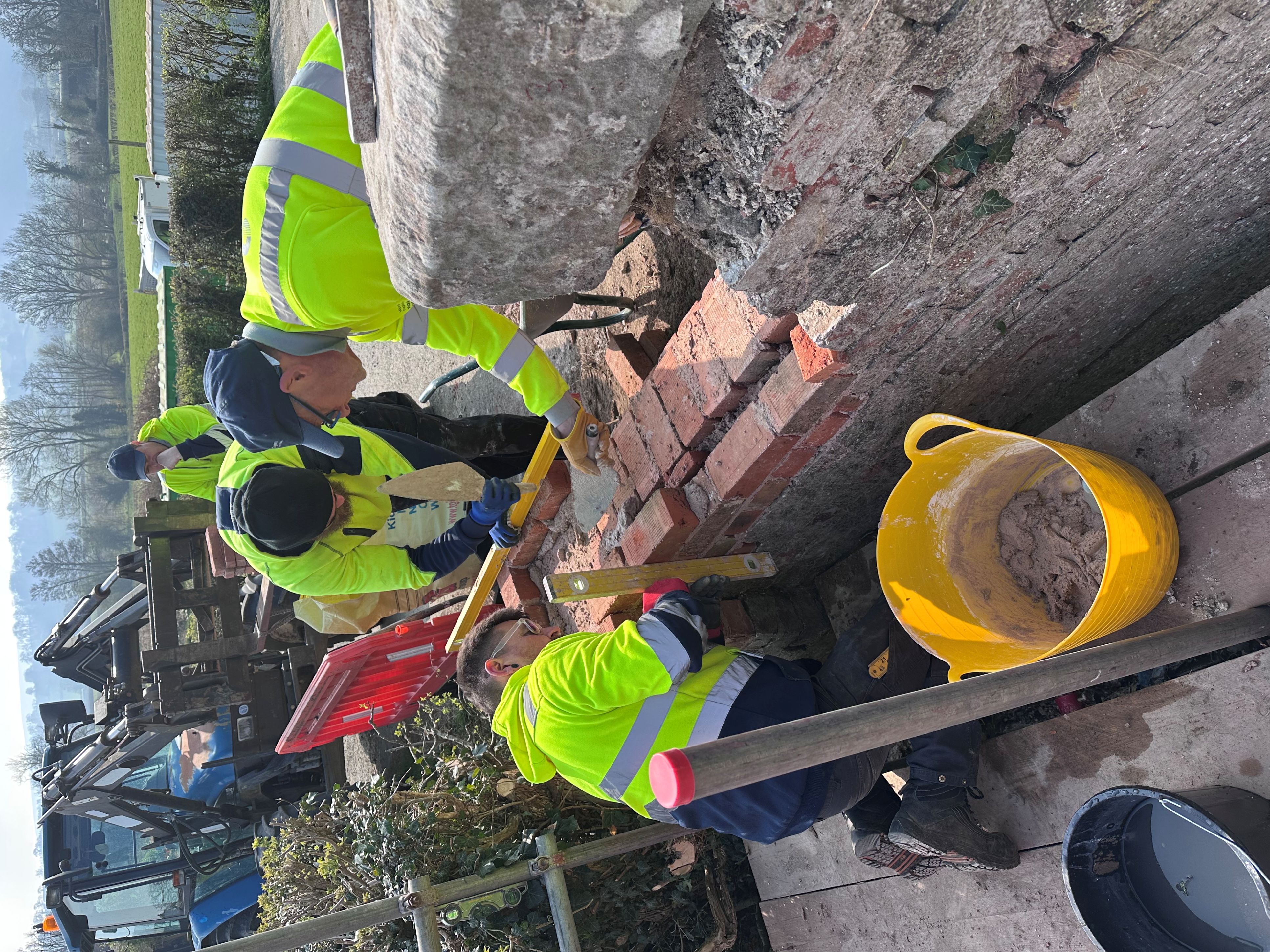
Training provided by us for the Canal and River Trust in the use of hot lime mortars gauged with pozolana near Oswestry
Canal-side groups are not building conservation students preparing for a career in the heritage sector; they are volunteers and maintenance staff who will return to their stretch of waterway and apply what they have learned within weeks. Our training is therefore immediately usable, rooted in the materials and structures they actually encounter, and honest about what a short course can achieve. The subjects and practical modules outlined above aim to give them not just skills, but the judgement to know when to use them—and when to call in a specialist.
Please contact us to arrange a date that suits us both. We usually require 4 weeks' notice.