Bramhall Hall Initial findings after the plaster collection from the upper Solar Chamber
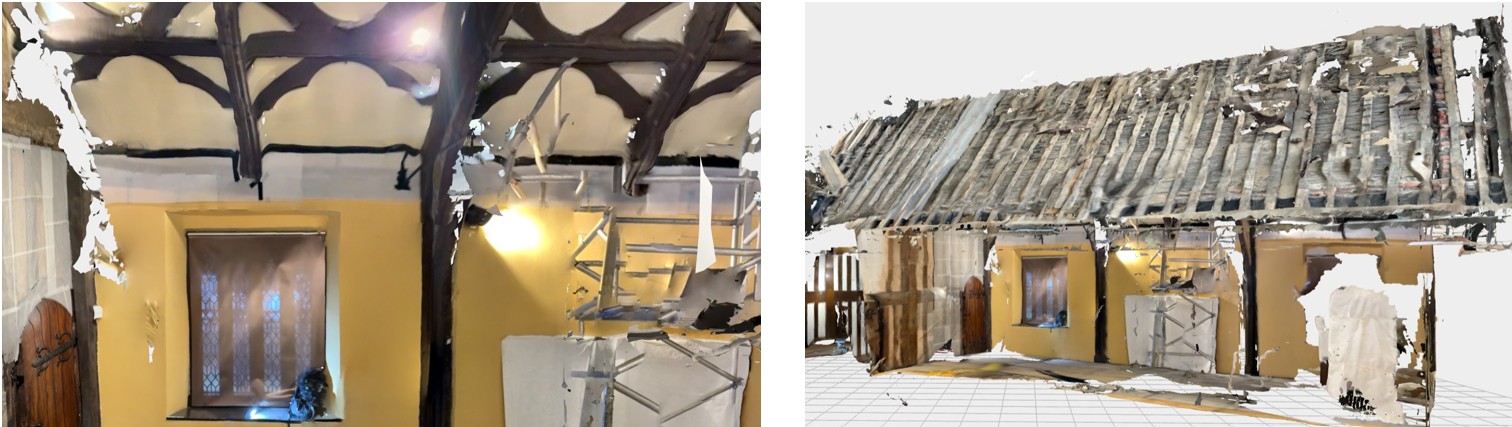
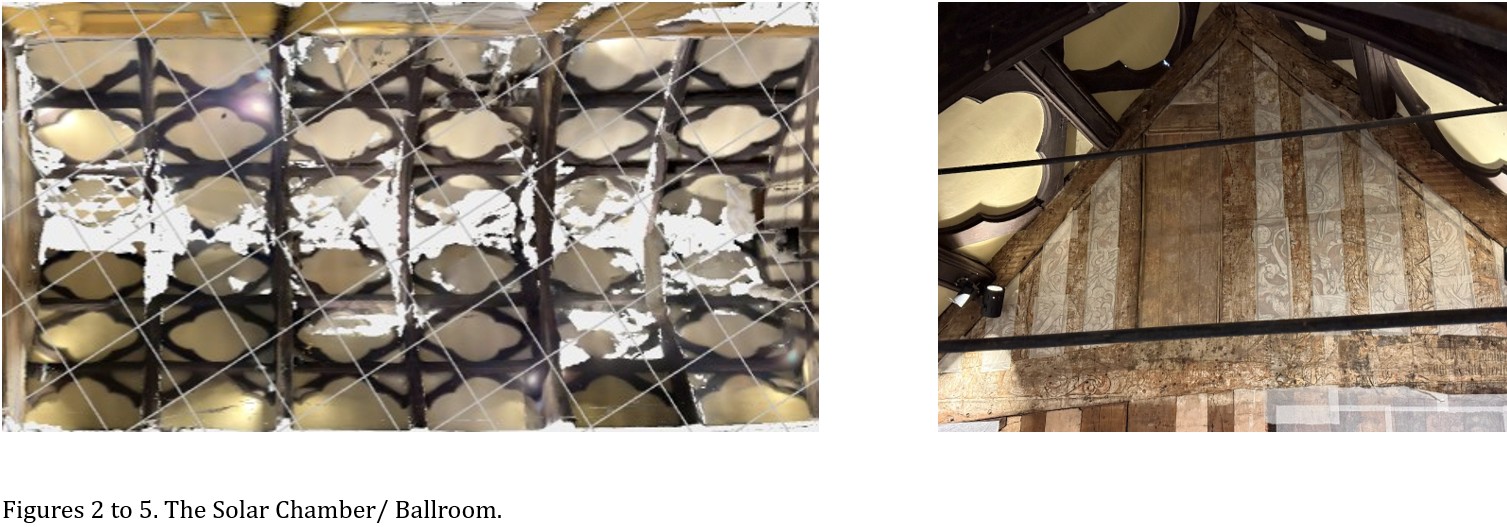
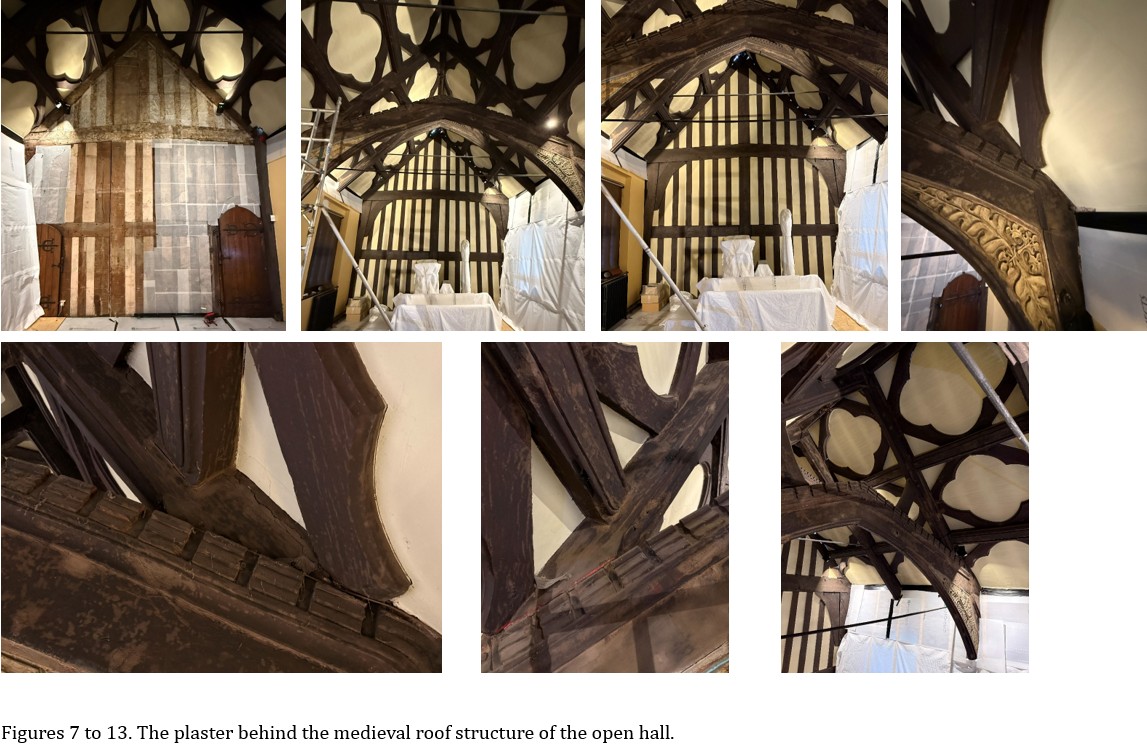
M Womersleys were asked to look at the makeup of the plaster in the Ball Room in the South Wing (Figures 2 to 5 & 7 to 13), previously a High-status upper chamber, to determine its likely age and significance. The plaster sits above a 15th-century timber-frame with close studs and an exposed medieval arch-braced tie-beam roof, with the cusped wind braces serving both decorative and structural purposes. The two main trusses within the room divide the space into three bays, each of which is bisected by intermediate principal rafters.
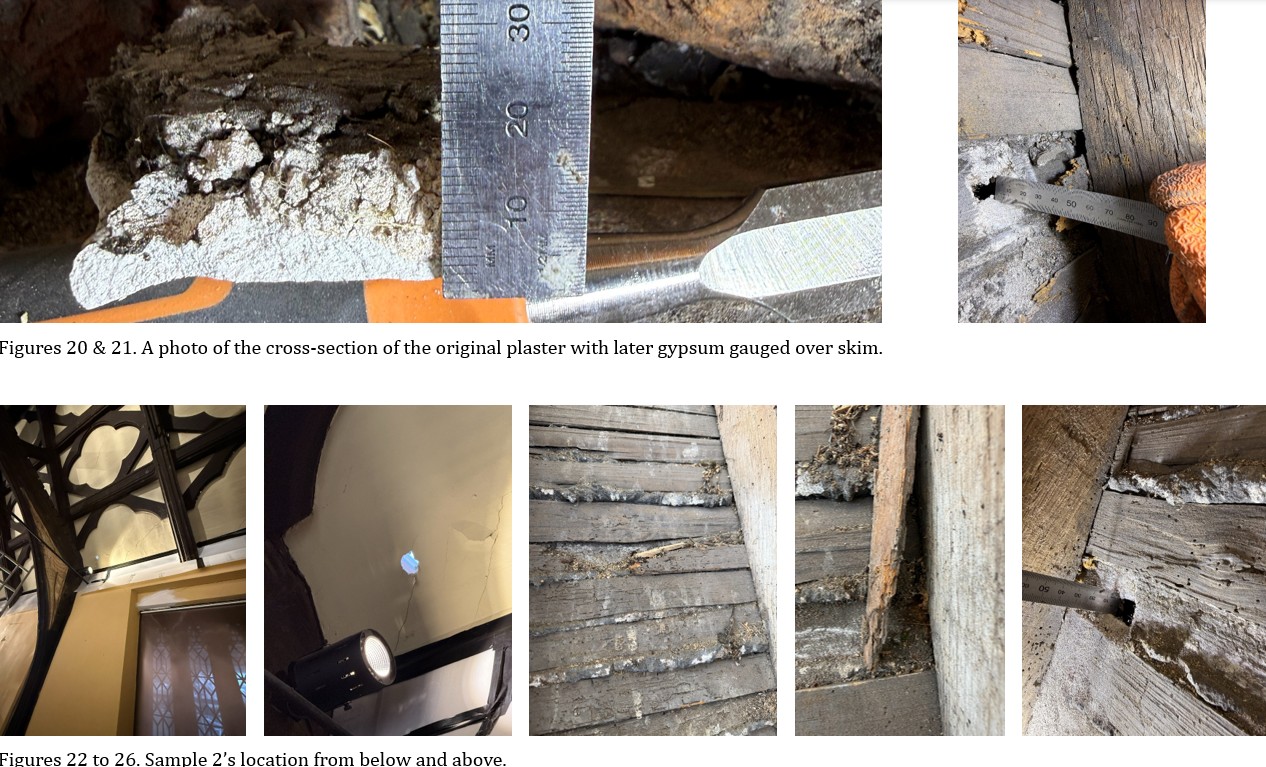
The original late medieval plaster in this area was likely to have consisted of clay-based undercoats topped with a tight lime finish coat. At some point, what appears to be thin oak riven lath was repaired or installed, and a thin layer of haired lime-rich plaster was introduced. The results of the mortar analysis at the end of this short report show that it was gauged with gypsum, which has given it some strength within the remaining sheets, which are significantly de-bonded from the lath in many areas. 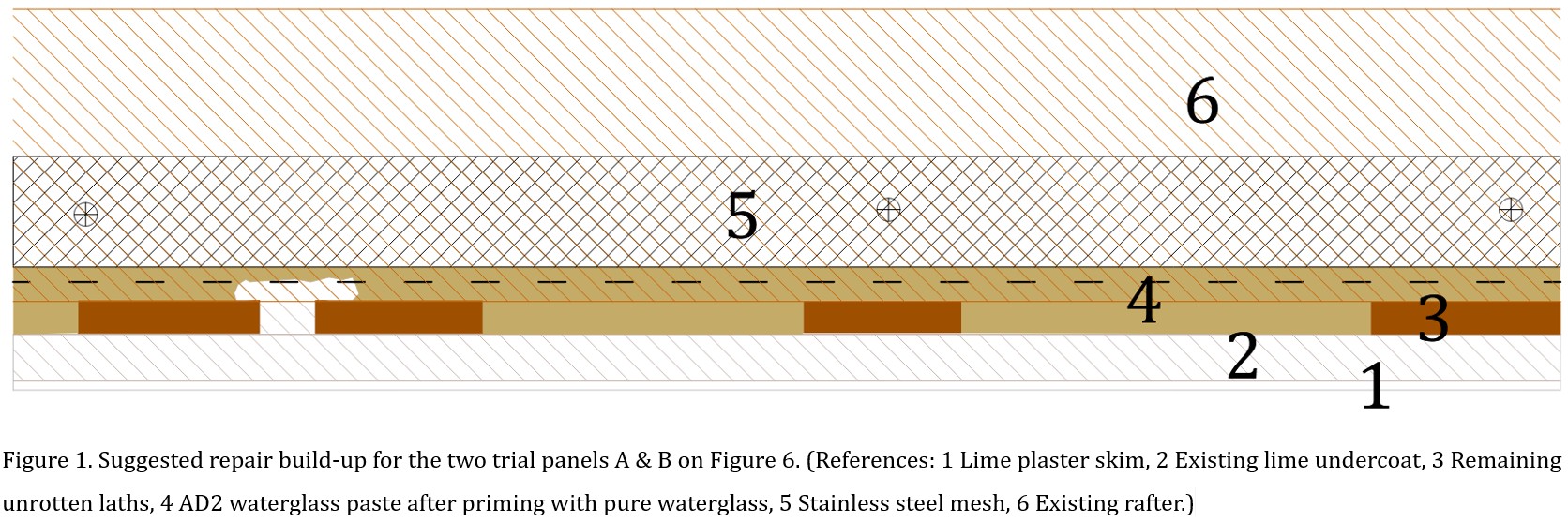
The historic interior was restored by Nevill in 1887; the south and west walls were clad in brick in the late eighteenth or early nineteenth century; the chimney stack was rebuilt in 1888; the brick west gable was repaired in 1950; and a replica timber-framing was applied to the inner bays. All these and many other works on the building may have affected the ceiling, requiring it to be re-lathed and replastered. The plaster seems to belong to the riven lath, and although it was not common to use these in the 1880’s, they were not unknown in high-status work.
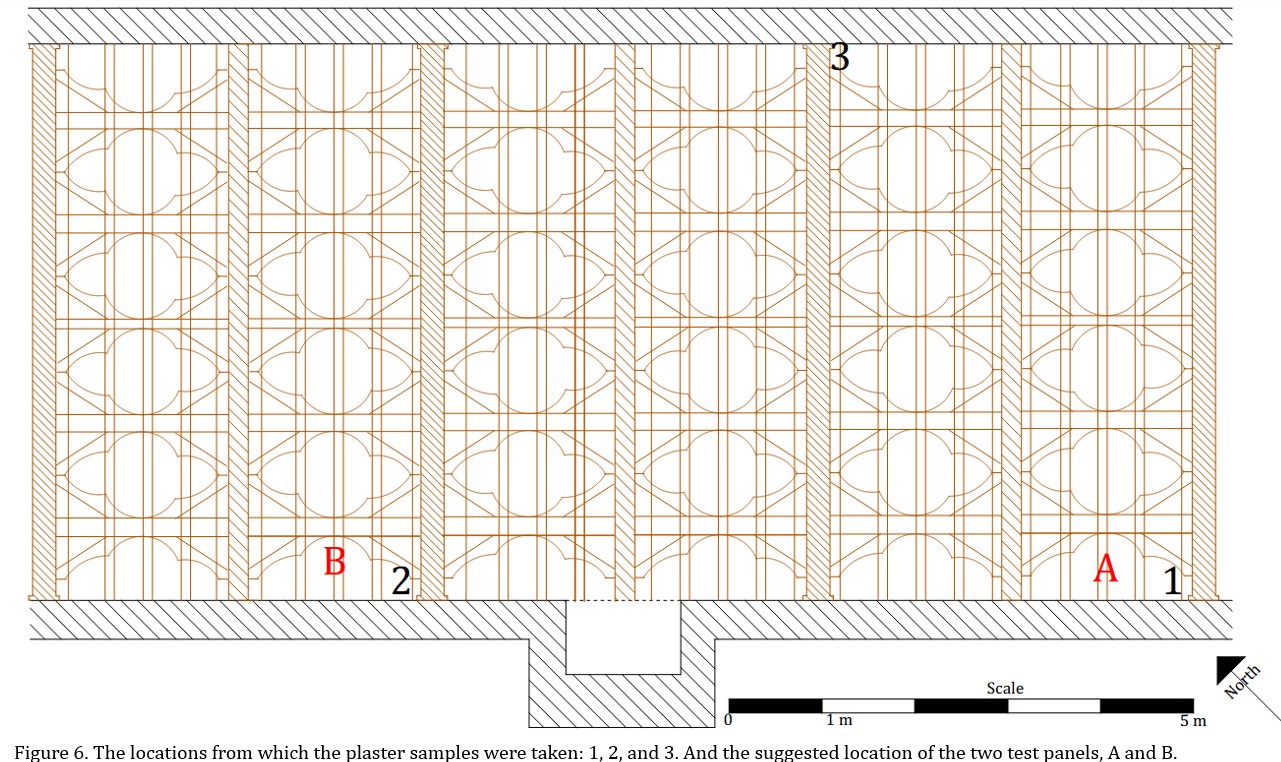
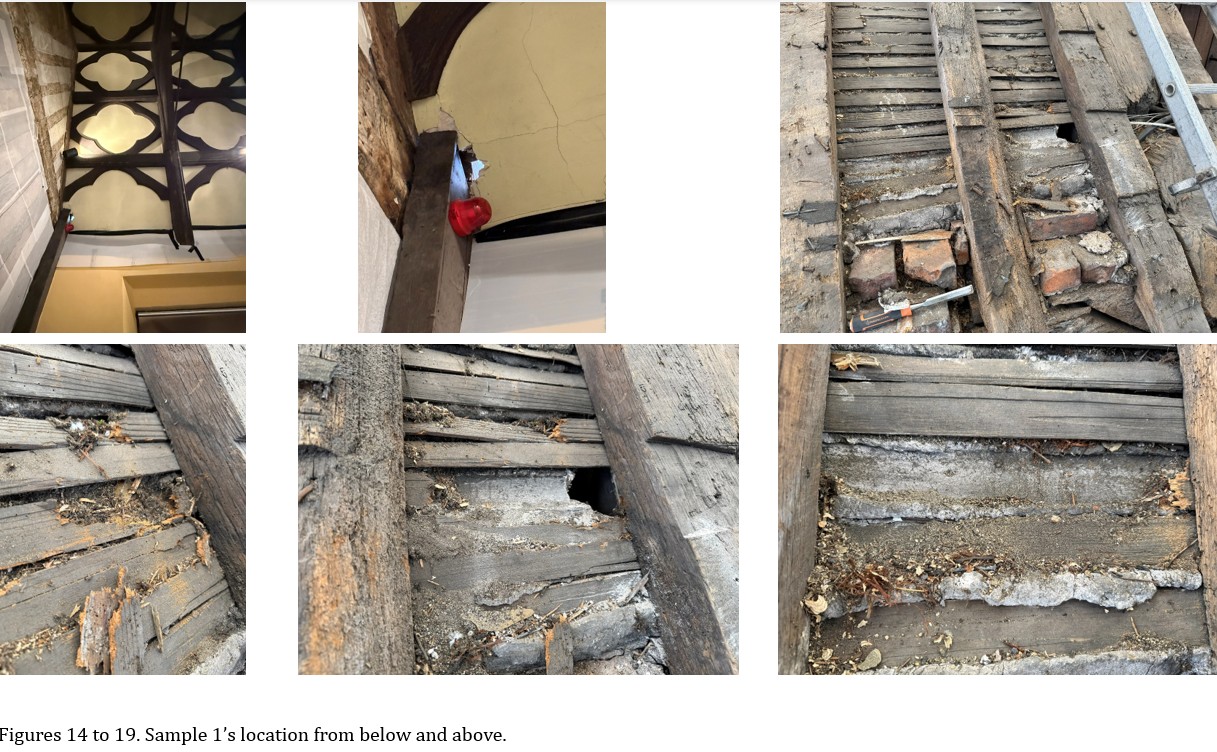
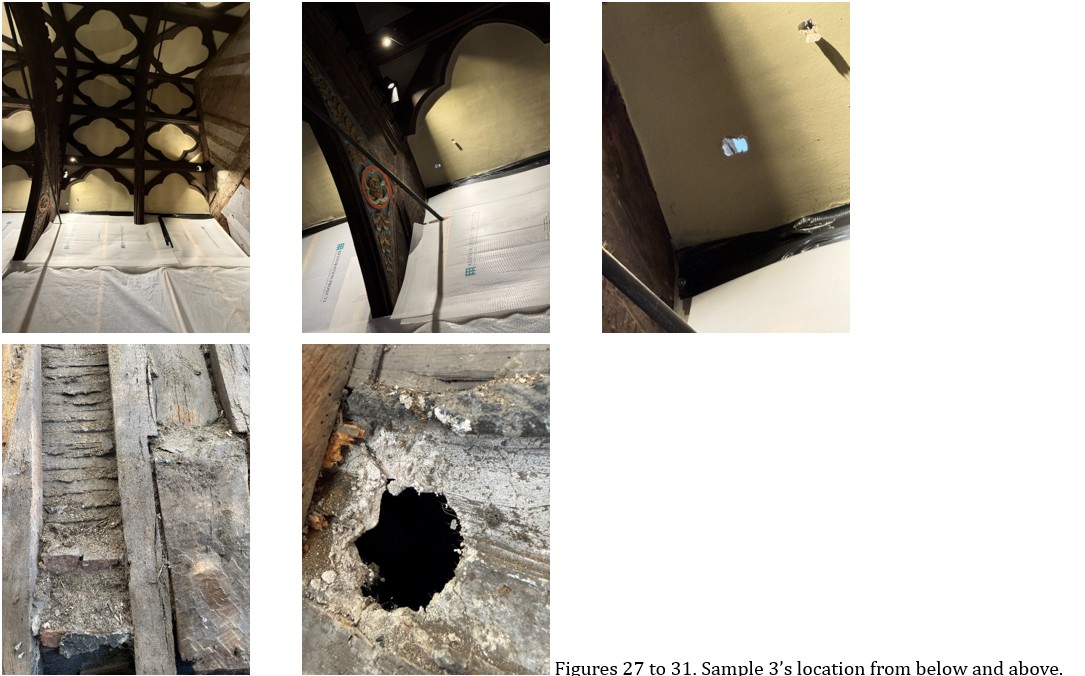
The mortar analysis of samples taken from three locations, see Figures 6 and 14 to 31, show that the lath and plaster could date from the mid-17th century, but that it could also be a later Victorian conservation work, especially bearing in mind the proportion of plaster of Paris used, which in higher status 17th century work tended to be reserved for ceilings that had ornate plaster decoration run onto them, which this one does not.
There are clearly two options: either replacing the lath and plaster if it is considered Victorian, or retaining it with significant conservation work required to save it. It would be possible to determine how effective its conservation would be and to provide an accurate price for this work by undertaking the repair of two of the most distressed sample panels, which others have identified as at the highest risk of falling plaster. The previous plaster survey by others identified several panels exhibiting live plaster, significant nib loss, springing laths, and timber decay, and, due to variable conditions, full consolidation is recommended.
One option is to use laminated plaster of Paris pads installed across the expanse, with screws and washers applied to the plaster face to stabilise delaminated face layers while supporting the ceiling during upper-side works. However, now we know how thin the plaster is, (necessitating more surface coverage with the repair material from above), the desire to put some insulation between rafters and the need to use a repair technique that will be more resistance to damp penetration and condensation in such a vulnerable location that Lime Green Silic8 Penetrating Primer could be used to consolidate the original plaster and provide additional bond strength after which could be applied a next coat of Silic8 AD2. The Silic8 Penetrating Primer does not contain plastics or resins; it is completely mineral-based, using Water Glass, which is breathable and durable. Please see Figure 1 below.
It is suggested that this is tseted with the two lower half quatrefoils, which are currently in a dangerous state, areas shown as A & B on Figure 6, are fully conserved using this Silic8 material linked to steel mesh wrapped around the edges of the rafters. For each panel, all decayed lath would be removed, and the whole area cleaned and primed with the Silic8 waterglass primer, left for 24 hours, then, over two days, Silic8 AD2, a mineral adhesive, would be applied to repair and consolidate lime-lath plaster.
Related Articles

Report on the most appropriate way to repair a stone plinth Gillygate York
M. Womersleys were asked by the owner of a property on Gillygate as to the best way to repair the plinth…

A scheme for the repair of the listed Barn and Granary perpendicular to Lily Hall, June 2026
Introduction M Womersleys were asked to prepare a scheme for the repair of the listed barn …

Paint analysis of a limited number of samples taken at Hall i’th Wood Museum, Hall i’th Wood Lane, Bolton
M Womersleys were asked to undertake some paint sampling at Hall i'th Wood Museum. Originally, this …