Investigations into the condition of the plastered ceilings at Enmore, just south of Sefton Park, Liverpool
Summary
M Womersleys surveyed and recorded some of the ground floor ceiling plaster at 34, Alexandra Drive, after a recent fire and years of neglect. We also undertook plaster analysis, assessed the bonding of the existing ceilings, and removed very loose and dangerous plasterwork beyond repair.
The Context: A Brief History of 34 Alexandra Drive
This Grade II Listed Building was constructed as a Victorian Villa named ‘Enmore’ in the 1860s, with money from the slave trade and a sugar plantation of the same name. The house was then extended and altered in the 1880s and 1890s for Richard Robertson Lockett with an interior decorative scheme by S J Waring & Sons. It was later used as a residential college and a nursing home, and, more recently, it fell into neglect and decay.
The ground floor displayed the rare survival of extensive decorative schemes by S J Waring & Sons, featuring the highest level of craftsmanship and materials, including the entrance hall, stair hall, dining room, drawing room, billiards room, and study. Mainly with an aesthetic revivalist or Jacobean character, with pendant and strapwork ceilings, and a delicate Rococo-style scheme to the drawing room.
The development of villas in and around Aigburth was stimulated by the laying out of Princes Park and Sefton Park in 1842-1843 and 1867-1872, respectively, as wealthy Liverpool merchant and shipowner families sought large plots on which to build, and pleasant surroundings away from the city centre. In the late 1870s, the house was bought by Richard Robertson Lockett (1846-1905), senior partner in W & J Lockett, merchants and shipowners. Richard Robertson Lockett extended the house several times. In the 1880s and 1890s, he commissioned the interior decorators and cabinetmakers S J Waring & Sons of Liverpool to redecorate, furnish, and complete the house's internal decorative schemes. In 1891 and 1896, the interior was photographed by the architectural photographers Bedford Lemere & Co, who had close associations with S J Waring & Sons.
The Dining Room
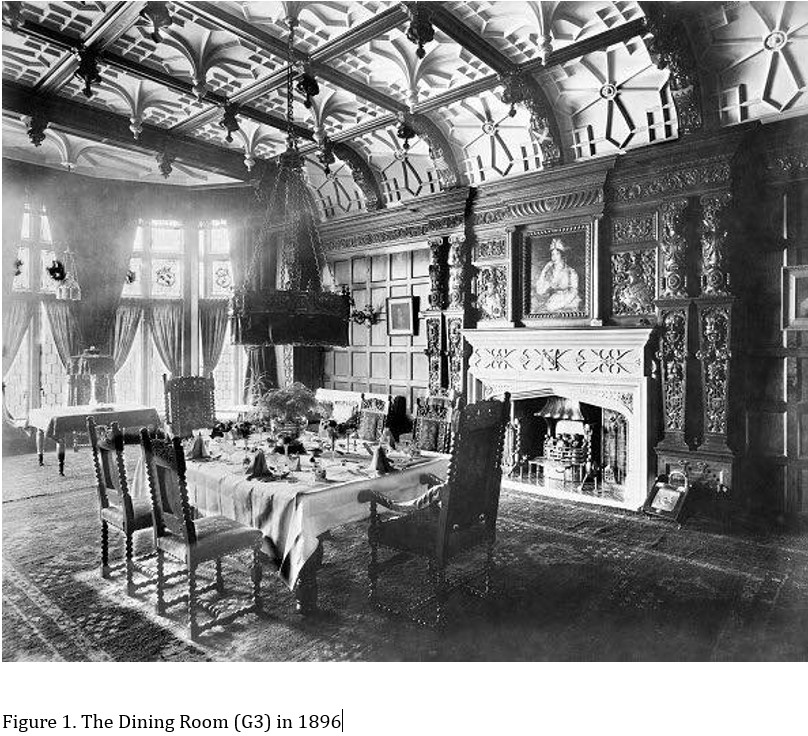
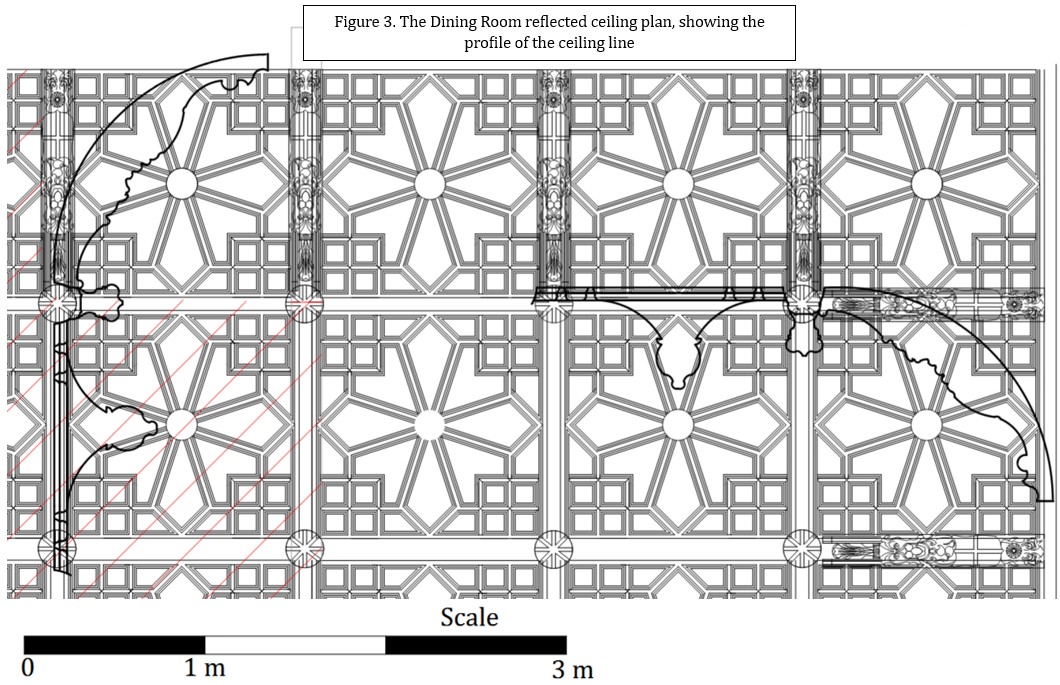
The Dining Room, photographed in 1896 (see Figure 1), has lost a significant portion of its ceiling due to water damage, as shown by the red hatchings in Figure 2. The beauty of the ceiling is shown in Figure 17, it is decorated in a late medieval revivalist style popular at the end of the 19th century, and features panel moulds that drop to form pendants on the flat sections, surrounded by deeper plaster ribs, forming larger square panels decorated with inverted crowns at their junctions—the whole ensemble created from fibrous panels. The Dining Room reflected-ceiling plan (Figure 3) shows the ceiling profile. Around three edges of the ceiling are deep coves, with the larger ribs that subdivide the ceiling, apparently supported by curving lion-headed console brackets bearing heraldic shields.
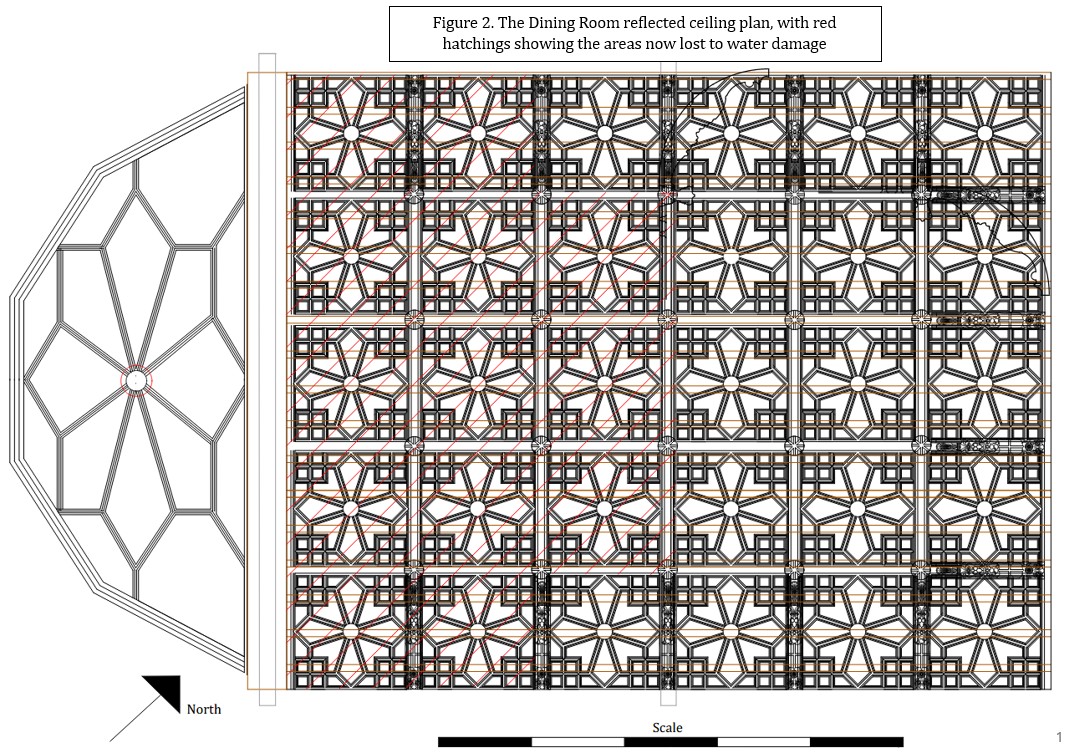
 The ceiling is made up of a series of fibrous cast panels, nailed and occasionally wadded to the ceiling joists. Water damage has unfortunately caused a significant portion of the ceiling to collapse, as illustrated in Figure 2. The damaged central ceiling terminates at a timber rib that encases a hidden steel beam, and the window bay beyond continues the panel moulding decoration, terminating in a single pendant.
The Study
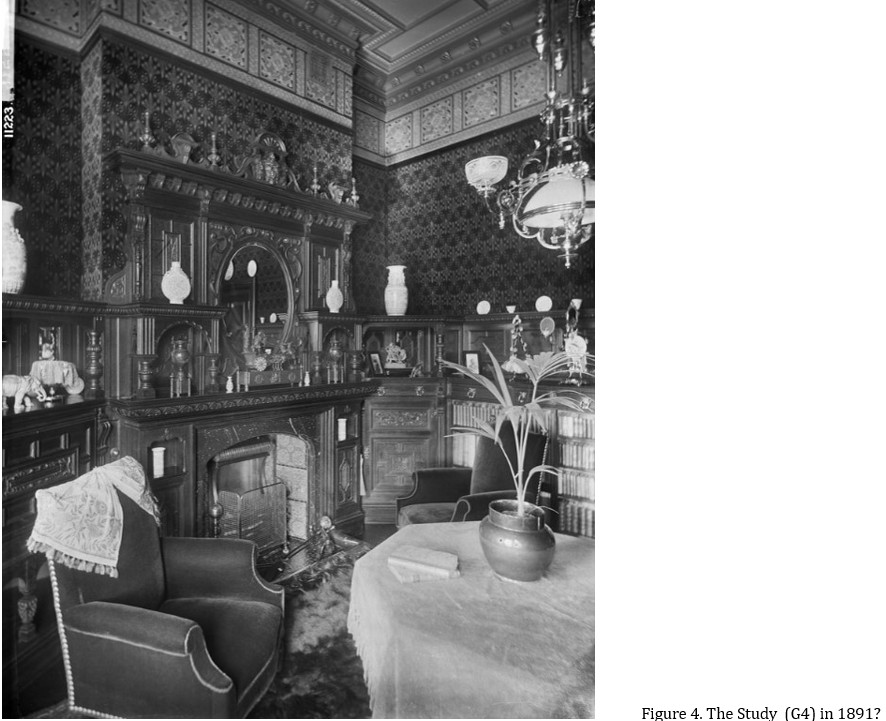
The Study is shown as it was in 1891 in Figure 4. The study ceiling is one of the earlier ones in the building, comprised of gypsum gauged lime plaster applied to timber riven laths, with some panel moulding run in situ and other sections run in casting plaster on the bench and fastened to a flat plastered surface. Continuing the theme of applied geometrical patterns formed on the ceilings with panel moulding. Figures 5 and 6 show the overall layout of the panelled design, the profile of the mouldings, and the deep cornice. The area hatched in red has already been lost to water damage, wet and dry rot. The whole ceiling-supporting timber structure and the laths have been ravaged by rot and dry rot. Fruiting bodies, together with a great multitude of mycelia, are visible.
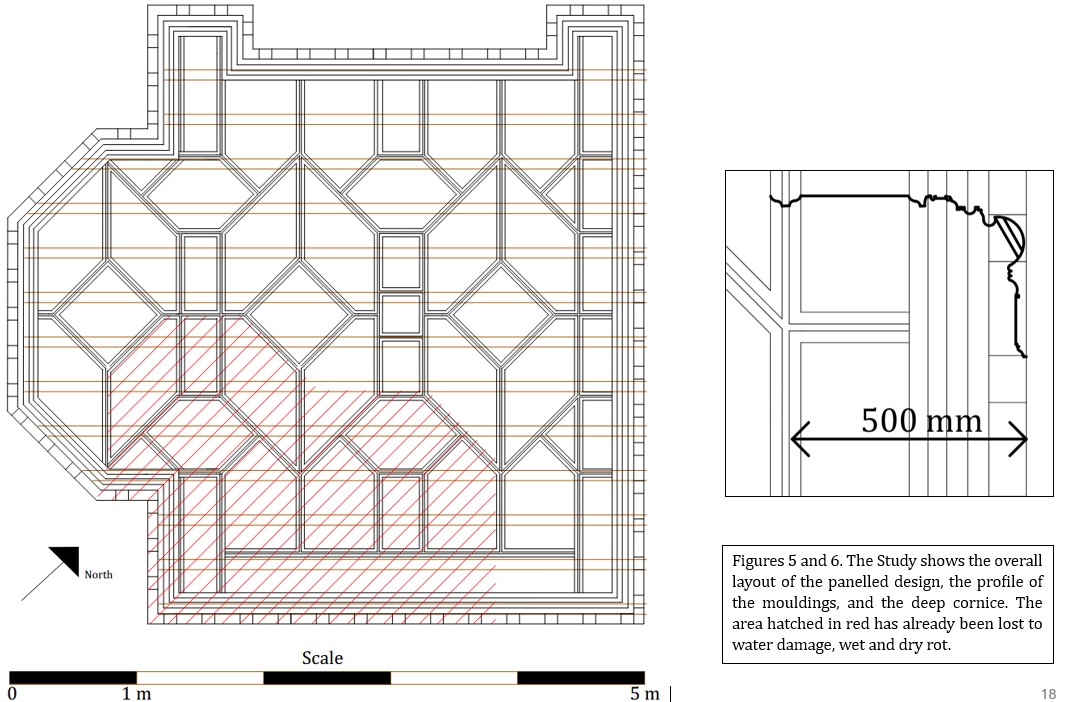
The cornice is also likely to be run in situ, with embedded laths forming part of the framework of supports, and decorative cast plaster forming the zig-zag pattern, the bead-and-reel, and the flower motifs, as well as miniature crenelations that decorate the square- and diamond-shaped panel designs.
The Hallways
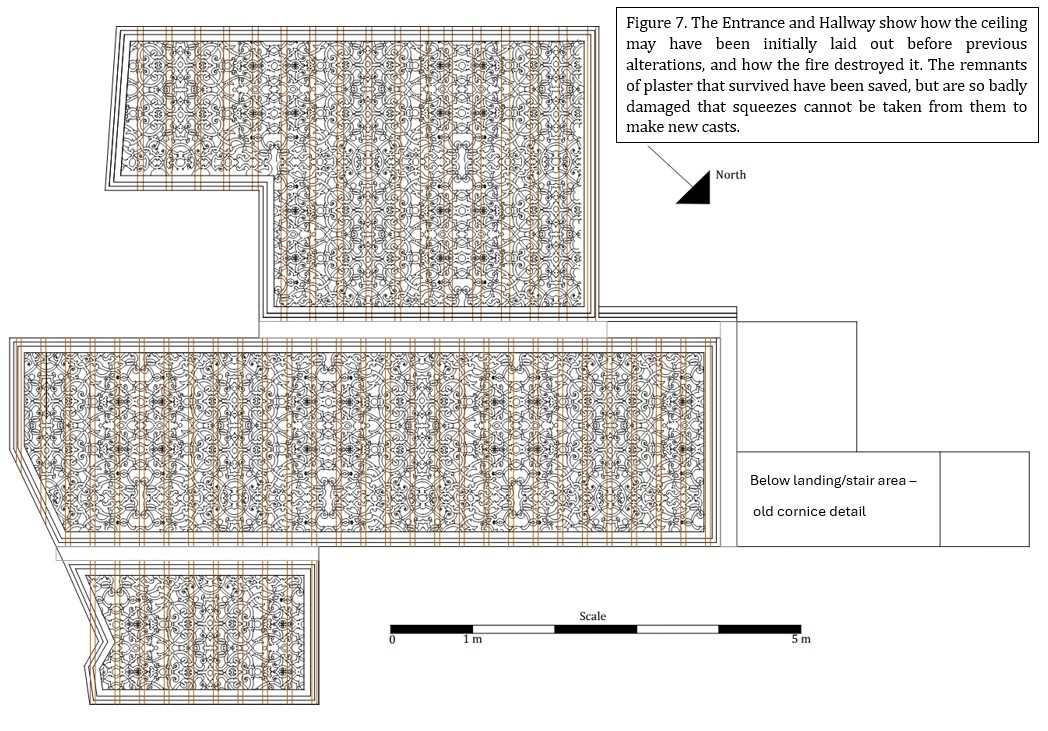
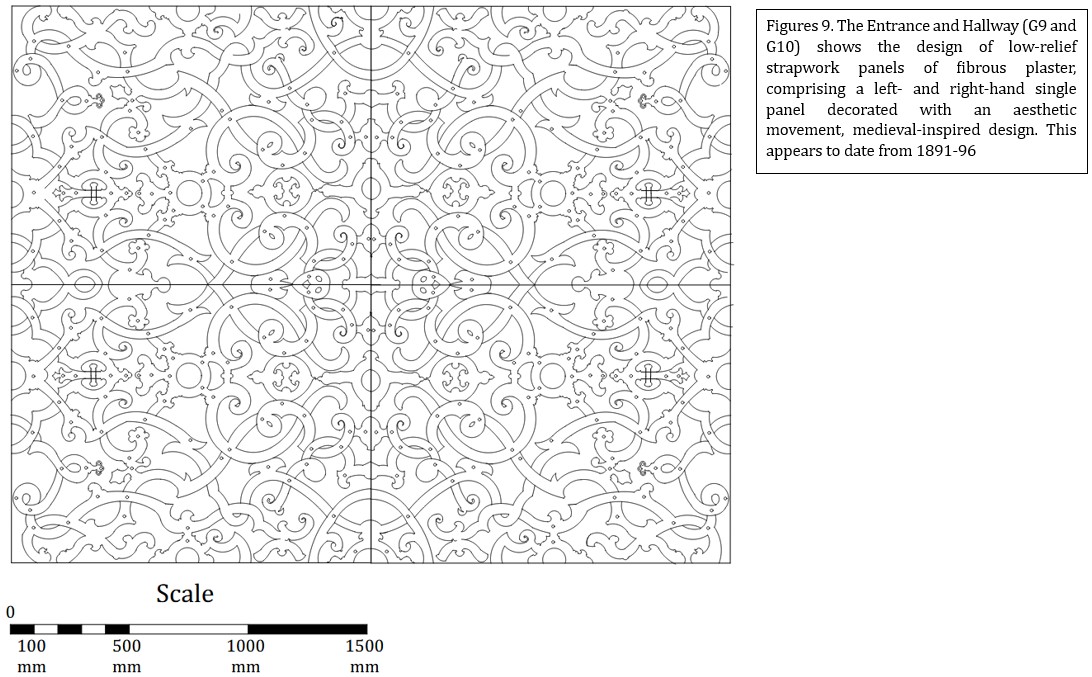
The listed building description states that the hall's late-C19 Jacobean-style relief-strapwork ceiling has been replaced with a plaster ceiling with lighter strapwork decoration. This appears to be based on an old photograph, but the author has not seen it. The lighter strapwork-decorated ceiling, as illustrated in Figure 7, may have existed before previous alterations, but the fire destroyed it. The surviving plaster remnants have been saved, but are so severely damaged that squeezes cannot be taken from them to make new casts. Figure 9. shows the design of the low-relief fibrous-plaster strapwork panels, comprising left- and right-handed single-panel designs, decorated in an aesthetic, medieval-inspired style. This could date from 1896.
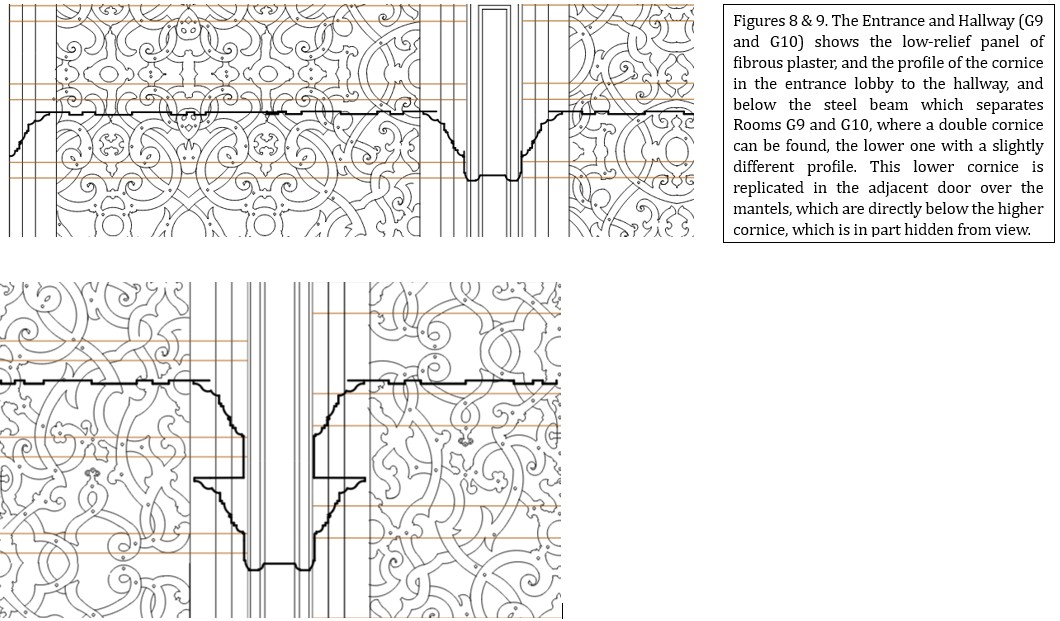
Figures 7 & 8 show the low-relief panel of fibrous plaster, the profile of the cornice in the entrance lobby to the hallway, and, below the steel beam separating Rooms G9 and G10, the profile of the double cornice, the lower one with a slightly different design. Remnants of the double cornice are visible hanging off the wall and the steel beam separating spaces G9 and G10. This lower cornice is replicated in the adjacent door overmantels, which are directly below the higher cornice, which is partially hidden from view. The entrance hall lobby comprises the same lightweight strapwork decorative panels and cornice that run throughout the main hallway—formed of fibrous cast strapwork panels and a simple cornice decorated with egg-and-dart. The inner hallway G9 had lost most of its ceiling to earlier alterations and then to the fire, but also appears to have been decorated with the same strapwork, fibrous casts throughout, and the same cornice detail as found in the main central hallway space.
 At the northwestern end of the hallway, in G10, the beams are visually supported by fine, fibrous Bacchus-headed console brackets with acanthus leaves below. Beyond them, under the stair landing, is an earlier cornice and lath and plaster ceiling, now all but destroyed by fire and water damage. An earlier ceiling cornice is located below the stair landing at the northwestern end of the hallway (see Figure 10). This cornice has been run in situ onto a solid background and laths, with planted medallion blocks, decorated with acanthus leaves, with raised flower motifs between them, and egg-and-dart decoration to the lowest band.
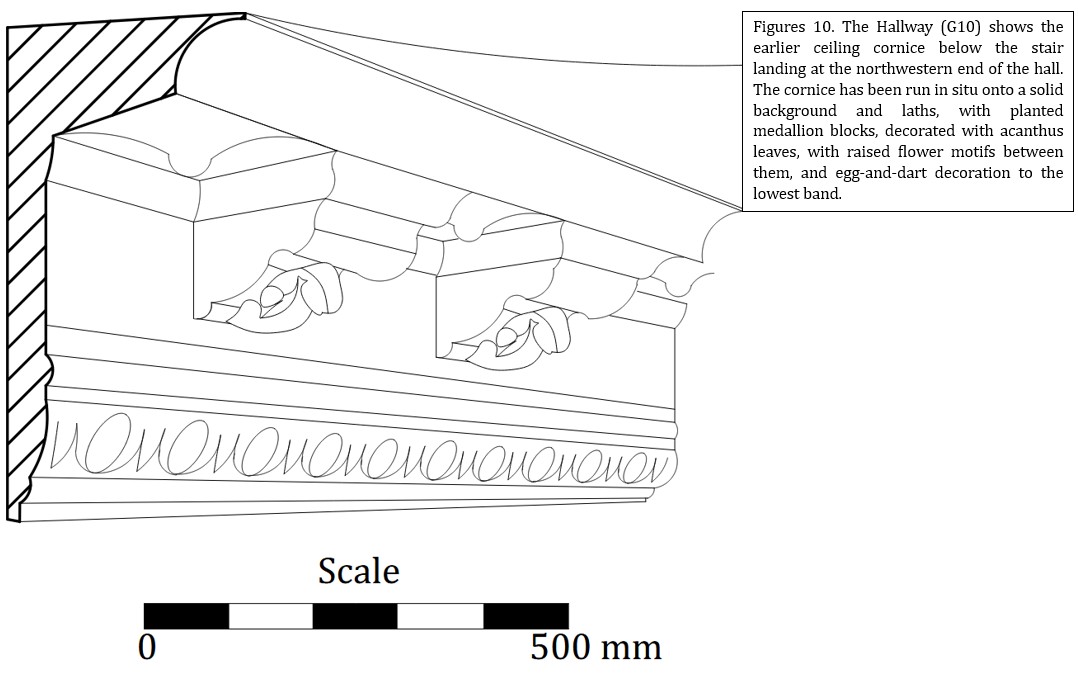
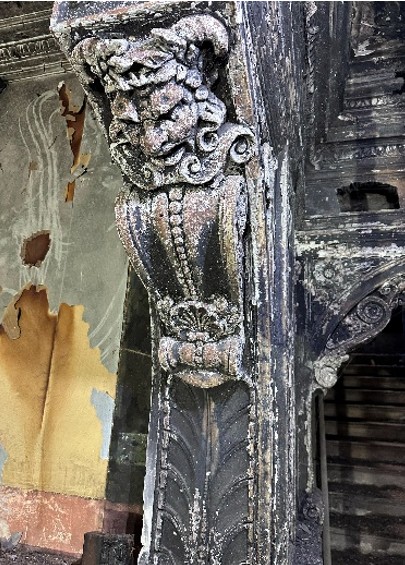
Figure 11. Bacchus-headed console brackets with acanthus leaves below
The Drawing Room
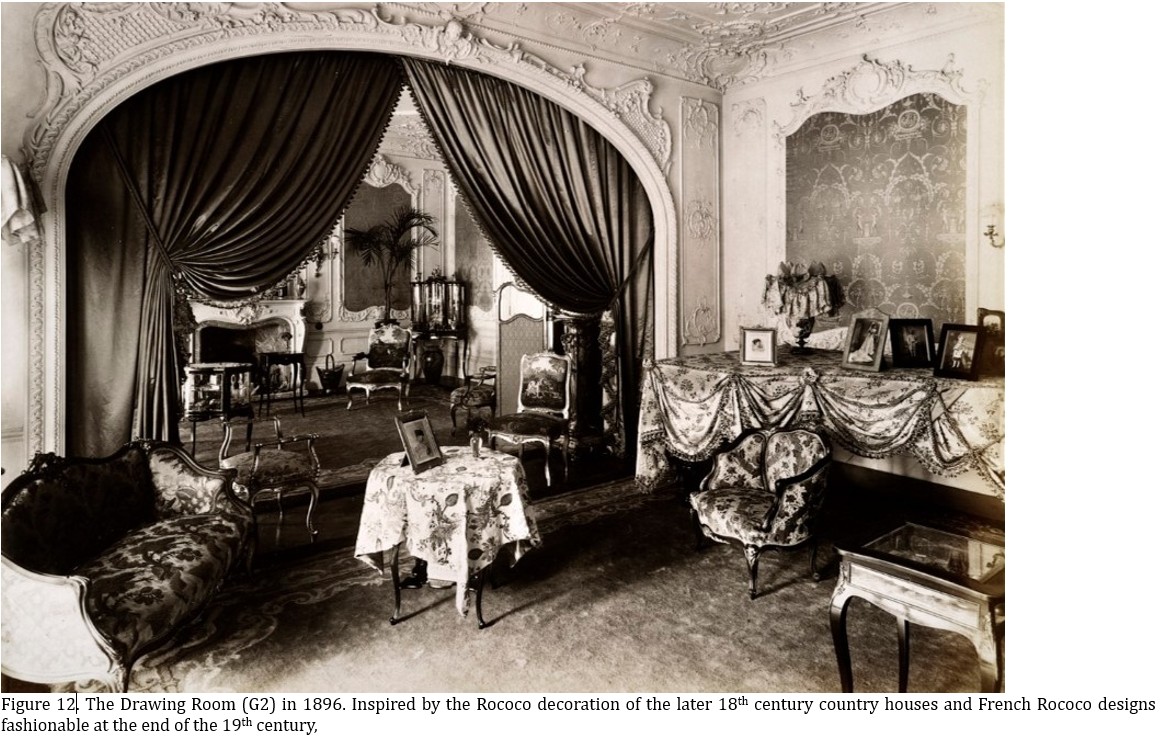
The Drawing Room shown in 1896 in Figure 12 is inspired by the Rococo decoration of late-18th-century country houses and by French Rococo designs fashionable at the end of the 19th century. It extends to decorate all the ceiling and wall areas. The lightweight, busy Rococo-designed ceiling, based on naturalistic foliage details, features cartouches decorated with cherubs, overmantels, and framed panels. This is all created from fibrous cast-plaster panels applied to the ceiling and walls. Unfortunately, the fire damage has caused delamination and loss of some upper layers of these panels, and has severely weakened others.
The fibrous ceiling panels are fastened directly to the undersides of the ceiling joists above them. The wall is covered with fibrous panels and wall decoration applied to a base of lime plaster gauged with gypsum, which is left plain for the larger flat panels, previously decorated with fabric or flock wallpaper.
In addition to severe deterioration of the fibrous panels themselves, with rotten hessian and salt-damaged plaster, the nailed supports, wads, and structural timber frameworks supporting them are failing. The arched opening requires cradle supports and fasteners on the back, as it is exposed from above. Similarly, decorative cartouches above fireplaces and decorative wall panels need mechanical fixings installed and wadding to prevent falls.
The Billiard Room
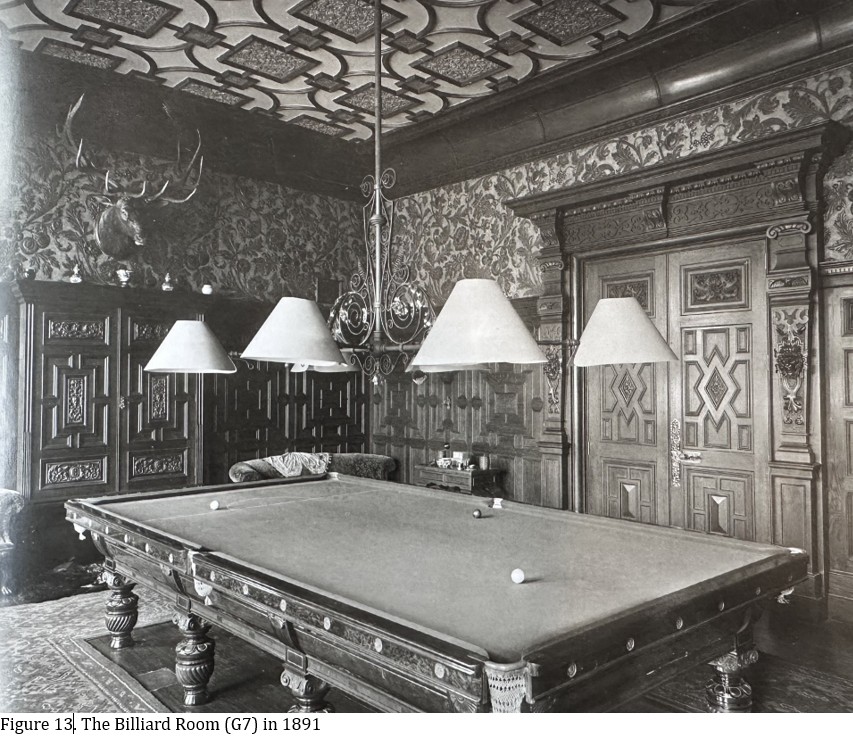
The plasterwork shown in the Billiard Room in 1891 (Figure 13) is now completely lost.
Related Articles

New training course dates in December for those who wish to learn how to use lime for repointing, building and plastering
M. Womersleys provides more in-depth training courses in the use of lime for building, pointing and …

A scheme of essential repair work prepared for the historic building: Rus In Urbe, Bridgetown
Introduction The Central Bank of Barbados has asked M Womersleys to prepare a scheme of essential repairs…

Anlysising historic renders and paints at Gregynog Hall
An initial render assessment together with mortar and paint analysis results. Buttress Architects, working…